
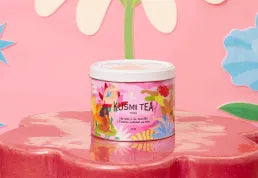
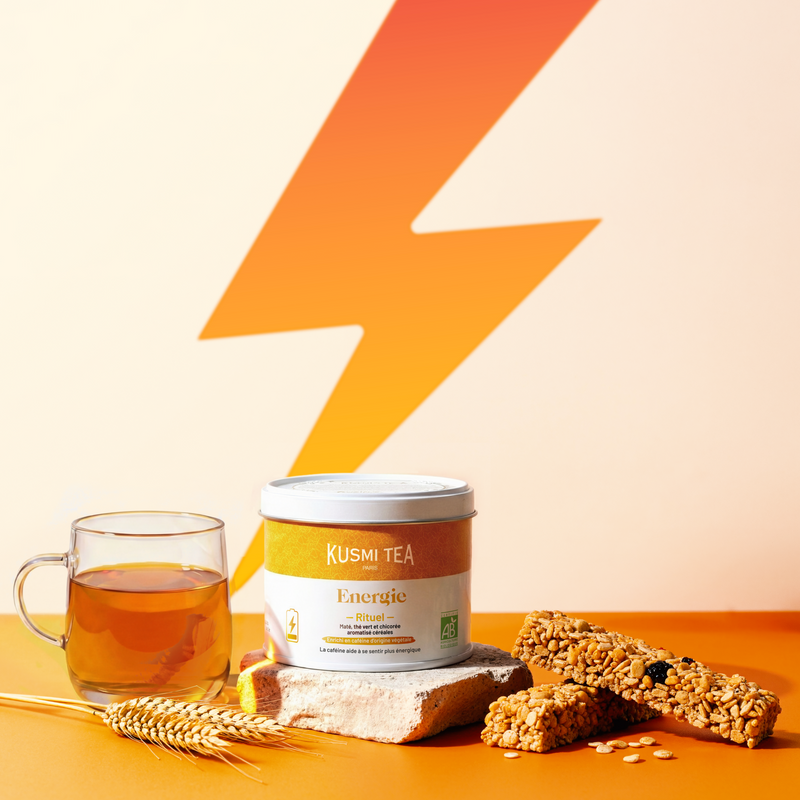

Energy Ritual Energizing green tea ❘ mate ❘ cereals ❘ caffeine ❘ organic
- Cereal flavored blend of mate, green tea, chicory and caffeine
- Notes of earthy and smooth cereal flavors
- Instant energy boost with organic ingredients


- Mate* (47%), green tea* (22%)
- Chicory* (20%), caffeine* (4%)
- Natural cereal flavor (3%), coating agent: sodium alginate of plant origin
- Natural aromas (cereal)
- *Organically grown ingredients
 Chicory
 Cereal (natural flavor)
 Mate
Mate
 Green Tea
 Caffeine (active ingredient)
 Chicory
 Cereal (natural flavor)
 Mate
Mate
 Green Tea
 Caffeine (active ingredient)
Available for click and collect
Join the KusmiKlub
Kusmi Tea Loyalty Programme: With every purchase, €1 spent = 1 point. Collect 70 points and receive a €5 voucher.*
3 interest-free instalments from €60
Secure payment system allowing you to pay in three (3) instalments free of charge. For more information, please consult ALMA’s Privacy and Data Management Policy.
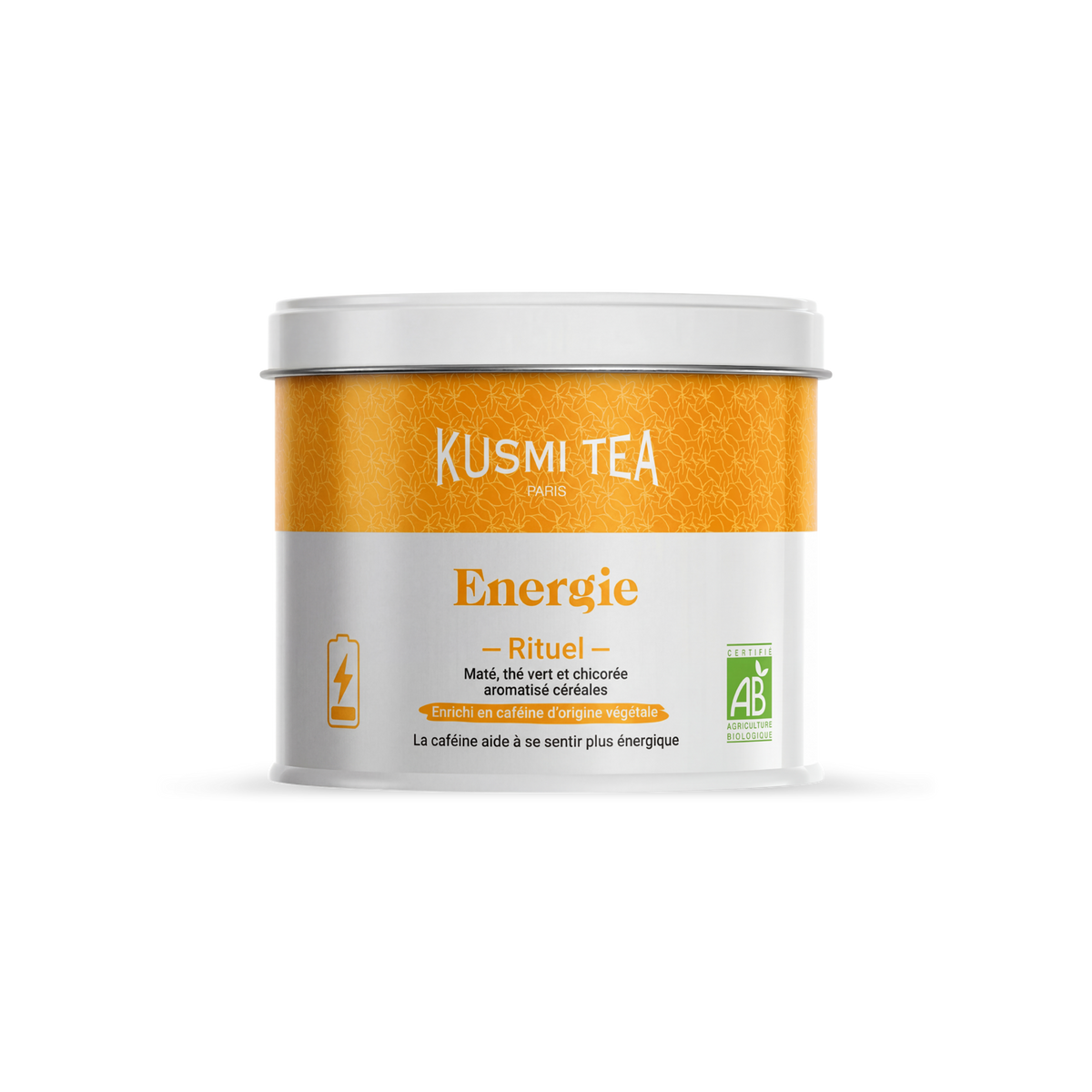
Energy Ritual
100 g tea-filled tin
AIX EN PROVENCE
2 Rue des Bagniers
13100 Aix En Provence
France
ANGERS
68 Rue du Mail
49100 Angers
France
BAB2
Avenue Jean Léon Laporte
64600 Anglet
France
TOULOUSE BLAGNAC
2 Allée Emile Zola
31700 Blagnac
France
BORDEAUX DIJEAUX
63 Rue de la Porte Dijeaux
33000 Bordeaux
France
BREST
Centre Commercial Le Phare de l'Europe 29 Rue de Gouesnou
29200 Brest
France
BORDEAUX BEGLES
1 Rue des Frères Lumière
33130 Bègles
France
AVANT CAP
Avenue du Plan de Campagne
13480 Cabriès
France
CAEN
25 Rue de Bras
14000 Caen
France
CHAMBERY
212 Place Saint-Léger
73000 Chambéry
France
CLERMONT FERRAND
Jaude Shopping Center 18 Rue d'Allagnat
63000 Clermont-Ferrand
France
LA ROCHELLE
8 Rue du Temple
17000 La Rochelle
France
LORIENT
78 Avenue Ambroise Croizat
56600 Lanester
France
LE HAVRE COTY
Centre commercial Espace Coty 22 Rue Casimir Périer
76600 Le Havre
France
CARRE SENART
3 Allée du Préambule Westfield Carré Sénart
77127 Lieusaint
France
LILLE ESQUERMOISE
13 Rue Esquermoise
59000 Lille
France
LIMOGES
33 Rue du Clocher
87000 Limoges
France
LYON JACOBINS
77 Rue du Président Édouard Herriot
69002 Lyon
France
LYON PARTDIEU
17 Rue du Docteur Bouchut
69003 Lyon
France
MARSEILLE LA VALENTINE
Centre Commercial La Valentine - Route de la Sabli
13011 Marseille
France
MARSEILLE TERRASSES
Les Terrasses du Port 9 Quai du Lazaret 2ème étage
13002 Marseille
France
METZ
2 Rue des Messageries
57000 Metz
France
MONTPELLIER POLYGONE
1, Rue des Pertuisanes CC Polygone
34000 Montpellier
France
BORDEAUX MERIGNAC
17 Avenue de la Somme
33700 Mérignac
France
NANCY
17 Rue Saint-Jean
54000 Nancy
France
NANTES PLACE ROYALE
3 Place Royale
44000 Nantes
France
NICE ETOILE
30 Avenue Jean Médecin
06000 Nice
France
NIMES
C. Cial Cap Costières 400 Avenue Claude Baillet
30900 NIMES
France
NOYELLES
Route Nationale 43
62950 Noyelles-Godault
France
ORLEANS
22 Rue de la République
45000 Orléans
France
COMPTOIR GRENELLE
68 rue de Grenelle
75007 Paris
France
GARE DE L'EST
Gare de l'est
75010 Paris
France
GARE MONTPARNASSE
17 Boulevard de Vaugirard
75015 Paris
France
GARE ST LAZARE
1 Cour de Rome Centre Commercial Gare Saint Lazare
75008 Paris
France
OPERA
49 Avenue de l'Opéra
75002 Paris
France
ROSIERS
56 Rue des Rosiers
75004 Paris
France
TERNES
60 Avenue des Ternes
75017 PARIS
France
SAINTE-CROIX
35 rue de sainte croix de la bretonnie
75004 PARIS 4
France
PERPIGNAN
3 Rue des Marchands
66000 Perpignan
France
POITIERS
44 Rue Gambetta
86000 Poitiers
France
CNIT LA DEFENSE
Centre commercial CNIT 2 Place de la Défense
92800 PUTEAUX
France
QUIMPER
163 Route de Bénodet C. CIAL LA GALERIE
29000 Quimper
France
STRASBOURG CŒUR ALSACE
6 Boulevard des Enseignes Shopping Promenade Cœur Alsace Bâtiment G
67116 Reichstett
France
RENNES ALMA
Centre commercial Rennes Alma 5 Rue du Bosphore
35200 Rennes
France
ROUEN
27 rue Ganterie
76000 Rouen
France
SAINT GERMAIN EN LAYE
16 Rue Collignon
78100 Saint Germain en laye
France
NANTES ATLANTIS
Boulevard Salvador Allende ZONE COMMERCIALE ATLANTIS
44800 Saint-Herblain
France
NICE CAP 3000
Centre commercial Cap3000 Nice Avenue Eugène Donadeï
06700 Saint-Laurent-du-Var
France
VAL D'EUROPE
Centre Commercial Val d'Europe, 14 Cours du Danube
77700 Serris
France
STRASBOURG
29 Rue des Hallebardes
67000 Strasbourg
France
TOULON GRAND VAR
Ctre Grand Var
83160 Toulon
France
TOULOUSE
39 Rue Boulbonne
31000 Toulouse
France
AEROVILLE
30 Rue des Buissons Aéroville Commercial Center Paris-Charles De Gaulle
95700 Tremblay-en-France
France
VANNES
13 Rue Saint-Vincent
56000 Vannes
France
VELIZY 2
2 Avenue de l'Europe
78140 Vélizy Villacoublay
France
Choose your format :
Choose your format :
Need a quick and effective boost? Energy Ritual is the perfect alternative to coffee to stay energetic, focused, and motivated at any time of the day!
This blend of green tea, mate, and chicory with delicious cereal notes is enriched with caffeine (without the taste of coffee!) and delivers the equivalent of an espresso or an energy drink. A real pick-me-up from the very first cup!
All in a healthy, natural, and gluten-free drink with smooth and generous flavors. Perfect for combining a pleasurable break with a clinically proven energizing effect!
The Ritual range combines the precision of science with the richness of plants. With this innovation, Kusmi Tea offers a coffee alternative designed to support your energy every day.
Energy Ritual, a concentrate of benefits:
- Instant energy boost
- Immediate anti-fatigue effect
- Increased alertness
- Enhanced motivation
- 1 cup of Energy Ritual = the equivalent of 1 espresso or an energy drink
Energy Ritual adapts to every moment: first thing in the morning, at the office, or before a workout. It helps you maintain your dynamism throughout the day while respecting your balance.
A premium tea house, Kusmi Tea crafts every recipe with the utmost care in its workshops in Normandy.
Our teas and infusions are made from ingredients rigorously selected for their quality and origins, then packaged in France.
*Organically grown ingredients.
Caffeine helps make you feel more energetic.
Kusmi Tea recommends drinking 2 g of infused blend with 1 cup of water per day as part of a healthy lifestyle and a varied, balanced diet.
Average nutrient values per 100 ml of tea**: Energy value: 0 kJ/ 0 Kcal. Contains negligible amounts of fat, saturated fatty acids, carbohydrates, sugar, protein and salt. Caffeine: 32 mg of caffeine per 100 ml.
**For 2g of blend infused for 3 minutes in 250 ml of 85°C water.
High caffeine content. Not recommended for children or pregnant or breast-feeding women (32 mg of caffeine per 100 ml).
At Kusmi Tea, we have chosen to incorporate caffeine in the form of an extract to concentrate all its benefits. Used for centuries in many cultures, caffeine is recognized for its natural stimulating effects on energy!
Theine vs. caffeine, what’s the difference? They are actually the same molecule, but absorbed differently by the body depending on the beverage! Coffee delivers a quick and intense effect, while tea releases caffeine more gradually thanks to tannins, providing a gentler and longer-lasting energy boost.
Today, caffeine is one of the most studied natural active ingredients for its effects on energy and alertness, with more than 90 clinical studies conducted on adults. Among these, 86% highlight a positive effect on the sensation of energy, alertness, and reaction speed!
To ensure the quality of our formulation, we collaborate with a laboratory specialized in plant analysis, led by a pharmacist expert in pharmacology. Regular analyses monitor the presence and correct dose of active ingredients to guarantee the full effectiveness of Energy Ritual.
[1] Clubley M, et al. Effects of caffeine and cyclizine alone and in combination on human performance, subjective effects and EEG activity. Br J Clin Pharmacol. 1979;7(2):157–163.
[2] Rapoport JL, et al. Behavioral and Cognitive Effects of Caffeine in Boys and Adult Males. J Nerv Ment Dis. 1981;169(11):726–732.
[3] Bruce M, et al. The psychopharmacological and electrophysiological effects of single doses of caffeine in healthy human subjects. Br J Clin Pharmacol. 1986;22(1):81–87.
[4] Kuznicki JT, Turner LS. The effects of caffeine on caffeine users and non-users. Physiol Behav. 1986;37(3):397–408.
[5] Lieberman HR, et al. The effects of low doses of caffeine on human performance and mood. Psychopharmacology. 1987;92(3):308–312.
[6] Swift CG, Tiplady B. The effects of age on the response to caffeine. Psychopharmacology. 1988;94(1):29–31.
[7] Smith AP, et al. Effects of Caffeine Given before and after Lunch on Sustained Attention. Neuropsychobiology. 1990;23(3):160–163.
[8] Zwyghuizen-Doorenbos A, et al. Effects of caffeine on alertness. Psychopharmacology. 1990;100(1):36–39.
[9] Rosenthal L, et al. Alerting effects of caffeine after normal and restricted sleep. Neuropsychopharmacology. 1991;4(2):103–108.
[10] Frewer LJ, Lader M. The effects of caffeine on two computerized tests of attention and vigilance. Hum Psychopharmacol. 1991;6(2):119–128.
[11] Yu G, et al. A comparison of the central nervous system effects of caffeine and theophylline in elderly subjects. Br J Clin Pharmacol. 1991;32(3):341–345.
[12] Smith AP, Kendrick AM, Maben AL. Effects of Breakfast and Caffeine on Performance and Mood in the Late Morning and after Lunch. Neuropsychobiology. 1992;26(4):198–204.
[13] Smith AP, et al. Investigation of the Effects of Coffee on Alertness and Performance during the Day and Night. Neuropsychobiology. 1993;27(4):217–223.
[14] Lorist MM, Snel J, Kok A. Influence of caffeine on information processing stages in well rested and fatigued subjects. Psychopharmacology. 1994;113(3–4):411–421.
[15] Fine BJ, et al. Effects of caffeine or diphenhydramine on visual vigilance. Psychopharmacology. 1994;114(2):233–238.
[16] Hasenfratz M, Bättig K. Acute dose-effect relationships of caffeine and mental performance, EEG, cardiovascular and subjective parameters. Psychopharmacology. 1994;114(2):281–287.
[17] Smith AP, Maben A, Brockman P. Effects of Evening Meals and Caffeine on Cognitive Performance, Mood and Cardiovascular Functioning. Appetite. 1994;22(1):57–65.
[18] Warburton DM. Effects of caffeine on cognition and mood without caffeine abstinence. Psychopharmacology. 1995;119(1):66–70.
[19] Robelin M, Rogers PJ. Mood and psychomotor performance effects of the first, but not of subsequent, cup-of-coffee equivalent doses of caffeine consumed after overnight caffeine abstinence. Behav Pharmacol. 1998;9(7):611–618.
[20] Hogervorst E, et al. Caffeine Improves Cognitive Performance After Strenuous Physical Exercise. Int J Sports Med. 1999;20(6):354–361.
[21] Smit HJ, Rogers PJ. Effects of low doses of caffeine on cognitive performance, mood and thirst in low and higher caffeine consumers. Psychopharmacology. 2000;152(2):167–173.
[22] Kamimori GH, et al. Effect of three caffeine doses on plasma catecholamines and alertness during prolonged wakefulness. Eur J Clin Pharmacol. 2000;56(8):537–544.
[23] Beaumont M, et al. Slow release caffeine and prolonged continuous wakefulness: effects on vigilance and cognitive performance. J Sleep Res. 2001;10(4):265–276.
[24] Kruk B, et al. Influence of caffeine, cold and exercise on multiple choice reaction time. Psychopharmacology. 2001;157(2):197–201.
[25] Liguori A, Robinson JH. Caffeine antagonism of alcohol-induced driving impairment. Drug Alcohol Depend. 2001;63(2):123–129.
[26] Lieberman H, et al. Effects of caffeine, sleep loss, and stress on cognitive performance and mood during U.S. Navy SEAL training. Psychopharmacology. 2002;164(3):250–261.
[27] Brice C, Smith A. Effects of caffeine on mood and performance: a study of realistic consumption. Psychopharmacology. 2002;164(2):188–192.
[28] Yeomans M, et al. Effects of caffeine on performance and mood depend on the level of caffeine abstinence. Psychopharmacology. 2002;164(3):241–249.
[29] Wesensten N, et al. Maintaining alertness and performance during sleep deprivation: modafinil versus caffeine. Psychopharmacology. 2002;159(3):238–247.
[30] Mackay M, Tiplady B, Scholey AB. Interactions between alcohol and caffeine in relation to psychomotor speed and accuracy. Hum Psychopharmacol. 2002;17(3):151–156.
[31] Watson J, Deary I, Kerr D. Central and peripheral effects of sustained caffeine use: tolerance is incomplete. Br J Clin Pharmacol. 2002;54(4):400–406.
[32] Smith A, et al. Caffeine and Central Noradrenaline: Effects on Mood, Cognitive Performance, Eye Movements and Cardiovascular Function. J Psychopharmacol. 2003;17(3):283–292.
[33] Magill RA, et al. Effects of Tyrosine, Phentermine, Caffeined-amphetamine, and Placebo on Cognitive and Motor Performance Deficits During Sleep Deprivation. Nutr Neurosci. 2003;6(4):237–246.
[34] Rogers PJ, et al. Absence of reinforcing, mood and psychomotor performance effects of caffeine in habitual non-consumers of caffeine. Psychopharmacology. 2003;167(1):54–62.
[35] Van Duinen H, Lorist MM, Zijdewind I. The effect of caffeine on cognitive task performance and motor fatigue. Psychopharmacology. 2005;180(3):539–547.
[36] Haskell CF, et al. Cognitive and mood improvements of caffeine in habitual consumers and habitual non-consumers of caffeine. Psychopharmacology. 2005;179(4):813–825.
[37] Rogers PJ, et al. Effects of caffeine and caffeine withdrawal on mood and cognitive performance degraded by sleep restriction. Psychopharmacology. 2005;179(4):742–752.
[38] Heatherley SV, et al. Cognitive and psychomotor performance, mood, and pressor effects of caffeine after 4, 6 and 8 h caffeine abstinence. Psychopharmacology. 2005;178(4):461–470.
[39] Christopher G, Sutherland D, Smith A. Effects of caffeine in non-withdrawn volunteers. Hum Psychopharmacol. 2005;20(1):47–53.
[40] Kohler M, Pavy A, Van Den Heuvel C. The effects of chewing versus caffeine on alertness, cognitive performance and cardiac autonomic activity during sleep deprivation. J Sleep Res. 2006;15(4):358–368.
[41] Childs E, De Wit H. Subjective, behavioral, and physiological effects of acute caffeine in light, nondependent caffeine users. Psychopharmacology. 2006;185(4):514–523.
[42] Deslandes A, et al. Effects of Caffeine on Electrophysiological and Neuropsychological Indices after Sleep Deprivation. Neuropsychobiology. 2006;54(2):126–133.
[43] Killgore WDS, et al. The Effects of Caffeine, Dextroamphetamine, and Modafinil on Humor Appreciation During Sleep Deprivation. Sleep. 2006;29(6):841–847.
[44] Barry RJ, et al. Caffeine effects on ERPs and performance in an auditory Go/NoGo task. Clin Neurophysiol. 2007;118(12):2692–2699.
[45] Hewlett P, Smith A. Effects of repeated doses of caffeine on performance and alertness: new data and secondary analyses. Hum Psychopharmacol. 2007;22(6):339–350.
[46] Attwood AS, Higgs S, Terry P. Differential responsiveness to caffeine and perceived effects of caffeine in moderate and high regular caffeine consumers. Psychopharmacology. 2007;190(4):469–477.
[47] Rogers PJ, et al. Time for tea: mood, blood pressure and cognitive performance effects of caffeine and theanine administered alone and together. Psychopharmacology. 2007;195(4):569–577.
[48] Haskell CF, et al. The effects of l-theanine, caffeine and their combination on cognition and mood. Biol Psychol. 2008;77(2):113–122.
[49] Killgore WDS, et al. Effects of dextroamphetamine, caffeine and modafinil on psychomotor vigilance test performance after 44 h of continuous wakefulness. J Sleep Res. 2008;17(3):309–321.
[50] Michael N, et al. Effects of caffeine on alertness as measured by infrared reflectance oculography. Psychopharmacology. 2008;200(2):255–260.
[51] Killgore WDS, et al. Sustaining Executive Functions During Sleep Deprivation: A Comparison of Caffeine, Dextroamphetamine, and Modafinil. Sleep. 2009;32(2):205–216.
[52] Adan A, Serra-Grabulosa JM. Effects of caffeine and glucose, alone and combined, on cognitive performance. Hum Psychopharmacol. 2010;25(4):310–317.
[53] Attwood A, Terry P, Higgs S. Conditioned effects of caffeine on performance in humans. Physiol Behav. 2010;99(3):286–293.
[54] Aggarwal R, et al. Effect of caffeine and taurine on simulated laparoscopy performed following sleep deprivation. Br J Surg. 2011;98(11):1666–1672.
[55] Giles GE, et al. Differential cognitive effects of energy drink ingredients: Caffeine, taurine, and glucose. Pharmacol Biochem Behav. 2012;102(4):569–577.
[56] Rogers PJ, et al. Faster but not smarter: effects of caffeine and caffeine withdrawal on alertness and performance. Psychopharmacology. 2013;226(2):229–240.
[57] Beaven CM, Ekström J. A Comparison of Blue Light and Caffeine Effects on Cognitive Function and Alertness in Humans. PLoS One. 2013;8(10):e76707.
[58] Peacock A, Martin FH, Carr A. Energy drink ingredients. Contribution of caffeine and taurine to performance outcomes. Appetite. 2013;64:1–4.
[59] Newman RA, et al. Caffeine Gum Minimizes Sleep Inertia. Percept Mot Skills. 2013;116(1):280–293.
[60] Smith AP. Effects of caffeine and alcohol on mood and performance changes following consumption of lager. Psychopharmacology. 2013;227(4):595–604.
[61] Smith AP, Christopher G, Sutherland D. Acute effects of caffeine on attention: a comparison of non-consumers and withdrawn consumers. J Psychopharmacol. 2013;27(1):77–83.
[62] Young HA, Benton D. Caffeine can decrease subjective energy depending on the vehicle with which it is consumed and when it is measured. Psychopharmacology. 2013;228(2):243–254.
[63] McIntire LK, et al. A Comparison of the Effects of Transcranial Direct Current Stimulation and Caffeine on Vigilance and Cognitive Performance During Extended Wakefulness. Brain Stimul. 2014;7(4):499–507.
[64] Ullrich S, et al. Feeling smart: Effects of caffeine and glucose on cognition, mood and self-judgment. Physiol Behav. 2015;151:629–637.
[65] Dodd FL, et al. A double-blind, placebo-controlled study evaluating the effects of caffeine and L-theanine both alone and in combination on cerebral blood flow, cognition and mood. Psychopharmacology. 2015;232(14):2563–2576.
[66] Franke AG, et al. Methylphenidate, modafinil, and caffeine for cognitive enhancement in chess: A double-blind, randomised controlled trial. Eur Neuropsychopharmacol. 2017;27(3):248–260.
[67] Kahathuduwa CN, et al. Acute effects of theanine, caffeine and theanine-caffeine combination on attention. Nutr Neurosci. 2017;20(6):369–377.
[68] Bello ML, et al. The effects of TeaCrine® and caffeine on endurance and cognitive performance during a simulated match in high-level soccer players. J Int Soc Sports Nutr. 2019;16(1):20.
[69] Souissi Y, Souissi M, Chtourou H. Effects of caffeine ingestion on the diurnal variation of cognitive and repeated high-intensity performances. Pharmacol Biochem Behav. 2019;177:69–74.
[70] Huffmyer JL, et al. Impact of Caffeine Ingestion on the Driving Performance of Anesthesiology Residents After 6 Consecutive Overnight Work Shifts. Anesth Analg. 2020;130(1):66–75.
[71] Sainz I, Collado-Mateo D, Coso JD. Effect of acute caffeine intake on hit accuracy and reaction time in professional e-sports players. Physiol Behav. 2020;224:113031.
[72] Repantis D, et al. Cognitive enhancement effects of stimulants: a randomized controlled trial testing methylphenidate, modafinil, and caffeine. Psychopharmacology. 2021;238(2):441–451.
[73] Khcharem A, et al. Acute caffeine ingestion improves 3-km run performance, cognitive function, and psychological state of young recreational runners. Pharmacol Biochem Behav. 2021;207:173219.
[74] Stepan ME, Altmann EM, Fenn KM. Caffeine selectively mitigates cognitive deficits caused by sleep deprivation. J Exp Psychol Learn Mem Cogn. 2021;47(9):1371–1382.
[75] Redondo B, et al. Effects of caffeine ingestion on dynamic visual acuity: a placebo-controlled, double-blind, balanced-crossover study in low caffeine consumers. Psychopharmacology. 2021;238(12):3391–3398.
[76] Sun F, et al. Effects of Caffeine on Performances of Simulated Match, Wingate Anaerobic Test, and Cognitive Function Test of Elite Taekwondo Athletes in Hong Kong. Nutrients. 2022;14(16):3398.
[77] Quiquempoix M, et al. Relationship between Habitual Caffeine Consumption, Attentional Performance, and Individual Alpha Frequency during Total Sleep Deprivation. Int J Environ Res Public Health. 2023;20(6):4971.
[78] Ramírez-delaCruz M, et al. Effects of different doses of caffeine on cognitive performance in healthy physically active individuals. Eur J Nutr. 2024;63(8):3025–3035.
[79] Wu SH, et al. Caffeine supplementation improves the cognitive abilities and shooting performance of elite e-sports players: a crossover trial. Sci Rep. 2024;14(1):2074.
[80] Główka N, et al. The dose-dependent effect of caffeine supplementation on performance, reaction time and postural stability in CrossFit - a randomized placebo-controlled crossover trial. J Int Soc Sports Nutr. 2024;21(1):2301384.
[81] Yoo C, et al. Paraxanthine provides greater improvement in cognitive function than caffeine after performing a 10-km run. J Int Soc Sports Nutr. 2024;21(1):2352779.
[82] Lints BS, et al. A caffeine and theacrine combination improves cognitive performance in tactical personnel under physically fatiguing conditions. J Int Soc Sports Nutr. 2025;22(1):2536146.
Frequently asked questions