

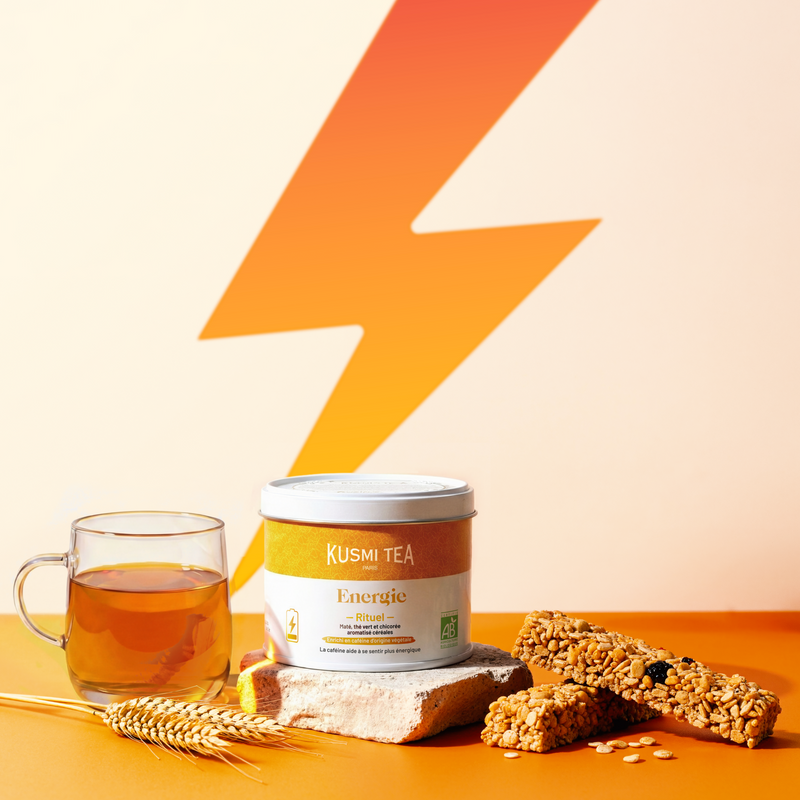

Energie Ritueel Energizing groene thee ❘ maté ❘ granen ❘ cafeïne ❘ bio
- Mengsel van maté, groene thee, cichorei, cafeïne, graanaroma
- Verleidelijke en zachte tonen van granen
- Directe energieboost, anti-vermoeidheidswerking


- Mate* (47%), groene thee* (22%)
- Chicorei* (20%), cafeïne* (4%)
- Natuurlijk graanaroma (3%), glansmiddel: natriumalginaat van plantaardige oorsprong
- Natuurlijke aroma’s (granenen)
- *Producten afkomstig van de biologische landbouw
 Cichorei
 Graan (natuurlijk aroma)
 Mate
Mate
 Groene thee
 Cafeïne (werkzame stof)
 Cichorei
 Graan (natuurlijk aroma)
 Mate
Mate
 Groene thee
 Cafeïne (werkzame stof)
Beschikbaar via click & collect
Word lid van de KusmiKlub
Kusmi Tea-loyaliteitsprogramma: bij elke aankoop is € 1 = 1 punt. Spaar 70 punten en ontvang een tegoedbon van € 5.*
Betaal gratis in 3 termijnen vanaf € 60
Veilig betalingssysteem waarmee u in drie (3) termijnen kosteloos kunt betalen. Raadpleeg voor meer informatie het privacy- en gegevensbeheerbeleid van ALMA.
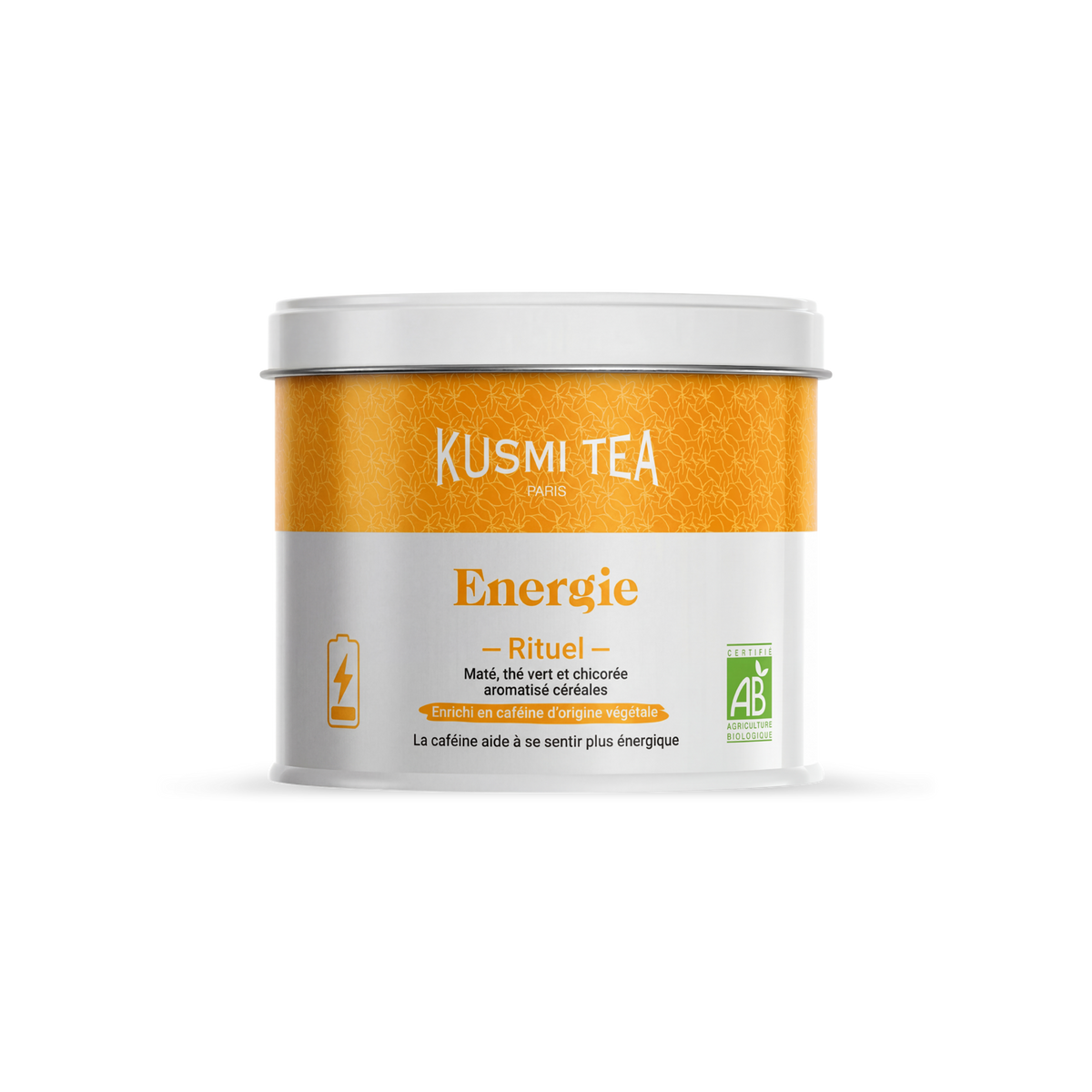
Energie Ritueel
Blik 100 g
AIX EN PROVENCE
2 Rue des Bagniers
13100 Aix En Provence
Frankrijk
ANGERS
68 Rue du Mail
49100 Angers
Frankrijk
BAB2
Avenue Jean Léon Laporte
64600 Anglet
Frankrijk
TOULOUSE BLAGNAC
2 Allée Emile Zola
31700 Blagnac
Frankrijk
BORDEAUX DIJEAUX
63 Rue de la Porte Dijeaux
33000 Bordeaux
Frankrijk
BREST
Centre Commercial Le Phare de l'Europe 29 Rue de Gouesnou
29200 Brest
Frankrijk
BORDEAUX BEGLES
1 Rue des Frères Lumière
33130 Bègles
Frankrijk
AVANT CAP
Avenue du Plan de Campagne
13480 Cabriès
Frankrijk
CAEN
25 Rue de Bras
14000 Caen
Frankrijk
CHAMBERY
212 Place Saint-Léger
73000 Chambéry
Frankrijk
CLERMONT FERRAND
Jaude Shopping Center 18 Rue d'Allagnat
63000 Clermont-Ferrand
Frankrijk
LA ROCHELLE
8 Rue du Temple
17000 La Rochelle
Frankrijk
LORIENT
78 Avenue Ambroise Croizat
56600 Lanester
Frankrijk
LE HAVRE COTY
Centre commercial Espace Coty 22 Rue Casimir Périer
76600 Le Havre
Frankrijk
CARRE SENART
3 Allée du Préambule Westfield Carré Sénart
77127 Lieusaint
Frankrijk
LILLE ESQUERMOISE
13 Rue Esquermoise
59000 Lille
Frankrijk
LIMOGES
33 Rue du Clocher
87000 Limoges
Frankrijk
LYON JACOBINS
77 Rue du Président Édouard Herriot
69002 Lyon
Frankrijk
LYON PARTDIEU
17 Rue du Docteur Bouchut
69003 Lyon
Frankrijk
MARSEILLE LA VALENTINE
Centre Commercial La Valentine - Route de la Sabli
13011 Marseille
Frankrijk
MARSEILLE TERRASSES
Les Terrasses du Port 9 Quai du Lazaret 2ème étage
13002 Marseille
Frankrijk
METZ
2 Rue des Messageries
57000 Metz
Frankrijk
MONTPELLIER POLYGONE
1, Rue des Pertuisanes CC Polygone
34000 Montpellier
Frankrijk
BORDEAUX MERIGNAC
17 Avenue de la Somme
33700 Mérignac
Frankrijk
NANCY
17 Rue Saint-Jean
54000 Nancy
Frankrijk
NANTES PLACE ROYALE
3 Place Royale
44000 Nantes
Frankrijk
NICE ETOILE
30 Avenue Jean Médecin
06000 Nice
Frankrijk
NIMES
C. Cial Cap Costières 400 Avenue Claude Baillet
30900 NIMES
Frankrijk
NOYELLES
Route Nationale 43
62950 Noyelles-Godault
Frankrijk
ORLEANS
22 Rue de la République
45000 Orléans
Frankrijk
COMPTOIR GRENELLE
68 rue de Grenelle
75007 Paris
Frankrijk
GARE DE L'EST
Gare de l'est
75010 Paris
Frankrijk
GARE MONTPARNASSE
17 Boulevard de Vaugirard
75015 Paris
Frankrijk
GARE ST LAZARE
1 Cour de Rome Centre Commercial Gare Saint Lazare
75008 Paris
Frankrijk
OPERA
49 Avenue de l'Opéra
75002 Paris
Frankrijk
ROSIERS
56 Rue des Rosiers
75004 Paris
Frankrijk
TERNES
60 Avenue des Ternes
75017 PARIS
Frankrijk
SAINTE-CROIX
35 rue de sainte croix de la bretonnie
75004 PARIS 4
Frankrijk
PERPIGNAN
3 Rue des Marchands
66000 Perpignan
Frankrijk
POITIERS
44 Rue Gambetta
86000 Poitiers
Frankrijk
CNIT LA DEFENSE
Centre commercial CNIT 2 Place de la Défense
92800 PUTEAUX
Frankrijk
QUIMPER
163 Route de Bénodet C. CIAL LA GALERIE
29000 Quimper
Frankrijk
STRASBOURG CŒUR ALSACE
6 Boulevard des Enseignes Shopping Promenade Cœur Alsace Bâtiment G
67116 Reichstett
Frankrijk
RENNES ALMA
Centre commercial Rennes Alma 5 Rue du Bosphore
35200 Rennes
Frankrijk
ROUEN
27 rue Ganterie
76000 Rouen
Frankrijk
SAINT GERMAIN EN LAYE
16 Rue Collignon
78100 Saint Germain en laye
Frankrijk
NANTES ATLANTIS
Boulevard Salvador Allende ZONE COMMERCIALE ATLANTIS
44800 Saint-Herblain
Frankrijk
NICE CAP 3000
Centre commercial Cap3000 Nice Avenue Eugène Donadeï
06700 Saint-Laurent-du-Var
Frankrijk
VAL D'EUROPE
Centre Commercial Val d'Europe, 14 Cours du Danube
77700 Serris
Frankrijk
STRASBOURG
29 Rue des Hallebardes
67000 Strasbourg
Frankrijk
TOULON GRAND VAR
Ctre Grand Var
83160 Toulon
Frankrijk
TOULOUSE
39 Rue Boulbonne
31000 Toulouse
Frankrijk
AEROVILLE
30 Rue des Buissons Aéroville Commercial Center Paris-Charles De Gaulle
95700 Tremblay-en-France
Frankrijk
VANNES
13 Rue Saint-Vincent
56000 Vannes
Frankrijk
VELIZY 2
2 Avenue de l'Europe
78140 Vélizy Villacoublay
Frankrijk
Kies uw formaat:
Kies uw formaat:
Heb je snel en effectief een boost nodig? Energie Ritueel is het ideale alternatief voor koffie om energiek, geconcentreerd en dus gemotiveerd te blijven, op elk moment van de dag!
Deze mix van groene thee, maté en cichorei met lekkere granenachtige tonen is verrijkt met cafeïne (zonder de koffiesmaak!) en levert het equivalent van een espresso of een energiedrankje. Een echte oppepper vanaf de eerste kop!
Dat alles in een gezonde, natuurlijke en glutenvrije drank, met zachte en rijke smaken. Perfect om een plezierige pauze te combineren met een klinisch bewezen stimulerend effect!
De Ritueel-lijn combineert de precisie van de wetenschap met de rijkdom van planten. Met deze innovatie biedt Kusmi Tea een alternatief voor koffie, ontworpen om je energie dagelijks te ondersteunen.
Energie Ritueel, een concentratie van voordelen:
- Directe energieboost
- Onmiddellijke anti-vermoeidheidswerking
- Verhoogde alertheid
- Versterkte motivatie
- 1 kop Energie Ritueel = het equivalent van 1 espresso of een energiedrankje
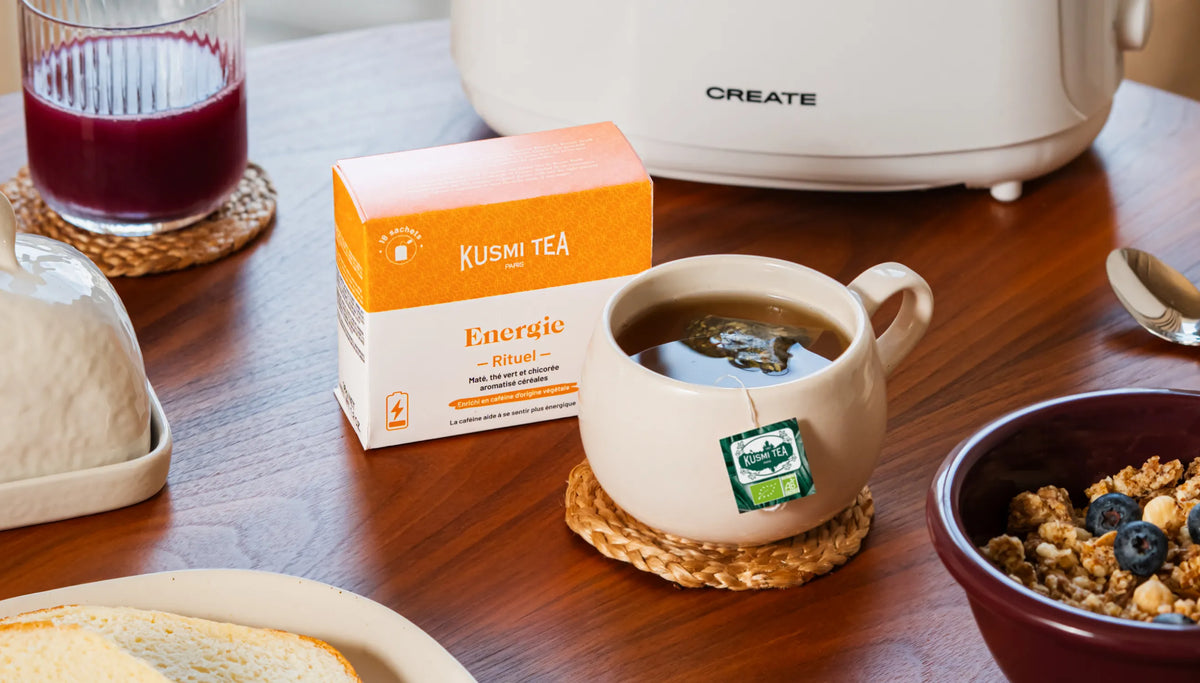
Energie Ritueel past zich aan elk moment aan: ’s ochtends bij het opstaan, op kantoor of voor een sportsessie. Het helpt je om je dynamiek de hele dag door te behouden, met respect voor je balans.
Beschikbaar los of in zakjes.
Als premium theehuis ontwikkelt Kusmi Tea elk recept met de grootste zorg in zijn ateliers in Normandië.
Onze theeën en infusies worden samengesteld met ingrediënten die zorgvuldig zijn geselecteerd op kwaliteit en herkomst, en vervolgens in Frankrijk verpakt.
*Producten afkomstig van de biologische landbouw
Cafeïne helpt je je energieker te voelen
Kusmi Tea raadt aan 1 kopje per dag te drinken, dus 2 g mengsel in het kader van een gezonde levensstijl en een gevarieerde en evenwichtige voeding
Gemiddelde voedingswaarden voor 100 ml thee** : Energetische waarde : 0kJ / 0 kcal. Bevat verwaarloosbare hoeveelheden vetten, verzadigde vetzuren, koolhydraten, suikers, eiwitten en zout. Cafeïne: 32 mg cafeïne per 100 ml
**Voor 2g mengsel dat u 3 minuten in 250 ml water van 85°C laat trekken
Hoog cafeïnegehalte. Niet aanbevolen voor kinderen en vrouwen die zwanger zijn of borstvoeding geven (32 mg cafeïne per 100 ml).
Bij Kusmi Tea hebben we ervoor gekozen cafeïne toe te voegen in de vorm van extract om al haar voordelen te concentreren. Al eeuwenlang gebruikt in vele culturen, staat cafeïne bekend om haar natuurlijke stimulerende effecten op energie!
Theïne versus cafeïne, wat is het verschil? Het gaat eigenlijk om dezelfde molecuul, maar het wordt verschillend door het lichaam opgenomen afhankelijk van de drank! Koffie zorgt voor een snel en intens effect, terwijl thee de cafeïne geleidelijker vrijgeeft dankzij de tannines, voor een zachtere en duurzamere energie.
Vandaag de dag is cafeïne een van de meest bestudeerde natuurlijke werkzame stoffen vanwege haar effecten op energie en alertheid, met meer dan 90 klinische studies uitgevoerd bij volwassenen. Hiervan tonen 86% een positief effect op het gevoel van energie, alertheid en reactietijd!
Om de kwaliteit van onze formulering te waarborgen, werken we samen met een laboratorium gespecialiseerd in plantanalyse, geleid door een apotheker en expert in farmacologie. Regelmatige analyses controleren de aanwezigheid en de juiste dosis van de werkzame stoffen om de volledige effectiviteit van Energie Ritueel te garanderen.
[1] Clubley M, et al. Effects of caffeine and cyclizine alone and in combination on human performance, subjective effects and EEG activity. Br J Clin Pharmacol. 1979;7(2):157–163.
[2] Rapoport JL, et al. Behavioral and Cognitive Effects of Caffeine in Boys and Adult Males. J Nerv Ment Dis. 1981;169(11):726–732.
[3] Bruce M, et al. The psychopharmacological and electrophysiological effects of single doses of caffeine in healthy human subjects. Br J Clin Pharmacol. 1986;22(1):81–87.
[4] Kuznicki JT, Turner LS. The effects of caffeine on caffeine users and non-users. Physiol Behav. 1986;37(3):397–408.
[5] Lieberman HR, et al. The effects of low doses of caffeine on human performance and mood. Psychopharmacology. 1987;92(3):308–312.
[6] Swift CG, Tiplady B. The effects of age on the response to caffeine. Psychopharmacology. 1988;94(1):29–31.
[7] Smith AP, et al. Effects of Caffeine Given before and after Lunch on Sustained Attention. Neuropsychobiology. 1990;23(3):160–163.
[8] Zwyghuizen-Doorenbos A, et al. Effects of caffeine on alertness. Psychopharmacology. 1990;100(1):36–39.
[9] Rosenthal L, et al. Alerting effects of caffeine after normal and restricted sleep. Neuropsychopharmacology. 1991;4(2):103–108.
[10] Frewer LJ, Lader M. The effects of caffeine on two computerized tests of attention and vigilance. Hum Psychopharmacol. 1991;6(2):119–128.
[11] Yu G, et al. A comparison of the central nervous system effects of caffeine and theophylline in elderly subjects. Br J Clin Pharmacol. 1991;32(3):341–345.
[12] Smith AP, Kendrick AM, Maben AL. Effects of Breakfast and Caffeine on Performance and Mood in the Late Morning and after Lunch. Neuropsychobiology. 1992;26(4):198–204.
[13] Smith AP, et al. Investigation of the Effects of Coffee on Alertness and Performance during the Day and Night. Neuropsychobiology. 1993;27(4):217–223.
[14] Lorist MM, Snel J, Kok A. Influence of caffeine on information processing stages in well rested and fatigued subjects. Psychopharmacology. 1994;113(3–4):411–421.
[15] Fine BJ, et al. Effects of caffeine or diphenhydramine on visual vigilance. Psychopharmacology. 1994;114(2):233–238.
[16] Hasenfratz M, Bättig K. Acute dose-effect relationships of caffeine and mental performance, EEG, cardiovascular and subjective parameters. Psychopharmacology. 1994;114(2):281–287.
[17] Smith AP, Maben A, Brockman P. Effects of Evening Meals and Caffeine on Cognitive Performance, Mood and Cardiovascular Functioning. Appetite. 1994;22(1):57–65.
[18] Warburton DM. Effects of caffeine on cognition and mood without caffeine abstinence. Psychopharmacology. 1995;119(1):66–70.
[19] Robelin M, Rogers PJ. Mood and psychomotor performance effects of the first, but not of subsequent, cup-of-coffee equivalent doses of caffeine consumed after overnight caffeine abstinence. Behav Pharmacol. 1998;9(7):611–618.
[20] Hogervorst E, et al. Caffeine Improves Cognitive Performance After Strenuous Physical Exercise. Int J Sports Med. 1999;20(6):354–361.
[21] Smit HJ, Rogers PJ. Effects of low doses of caffeine on cognitive performance, mood and thirst in low and higher caffeine consumers. Psychopharmacology. 2000;152(2):167–173.
[22] Kamimori GH, et al. Effect of three caffeine doses on plasma catecholamines and alertness during prolonged wakefulness. Eur J Clin Pharmacol. 2000;56(8):537–544.
[23] Beaumont M, et al. Slow release caffeine and prolonged continuous wakefulness: effects on vigilance and cognitive performance. J Sleep Res. 2001;10(4):265–276.
[24] Kruk B, et al. Influence of caffeine, cold and exercise on multiple choice reaction time. Psychopharmacology. 2001;157(2):197–201.
[25] Liguori A, Robinson JH. Caffeine antagonism of alcohol-induced driving impairment. Drug Alcohol Depend. 2001;63(2):123–129.
[26] Lieberman H, et al. Effects of caffeine, sleep loss, and stress on cognitive performance and mood during U.S. Navy SEAL training. Psychopharmacology. 2002;164(3):250–261.
[27] Brice C, Smith A. Effects of caffeine on mood and performance: a study of realistic consumption. Psychopharmacology. 2002;164(2):188–192.
[28] Yeomans M, et al. Effects of caffeine on performance and mood depend on the level of caffeine abstinence. Psychopharmacology. 2002;164(3):241–249.
[29] Wesensten N, et al. Maintaining alertness and performance during sleep deprivation: modafinil versus caffeine. Psychopharmacology. 2002;159(3):238–247.
[30] Mackay M, Tiplady B, Scholey AB. Interactions between alcohol and caffeine in relation to psychomotor speed and accuracy. Hum Psychopharmacol. 2002;17(3):151–156.
[31] Watson J, Deary I, Kerr D. Central and peripheral effects of sustained caffeine use: tolerance is incomplete. Br J Clin Pharmacol. 2002;54(4):400–406.
[32] Smith A, et al. Caffeine and Central Noradrenaline: Effects on Mood, Cognitive Performance, Eye Movements and Cardiovascular Function. J Psychopharmacol. 2003;17(3):283–292.
[33] Magill RA, et al. Effects of Tyrosine, Phentermine, Caffeined-amphetamine, and Placebo on Cognitive and Motor Performance Deficits During Sleep Deprivation. Nutr Neurosci. 2003;6(4):237–246.
[34] Rogers PJ, et al. Absence of reinforcing, mood and psychomotor performance effects of caffeine in habitual non-consumers of caffeine. Psychopharmacology. 2003;167(1):54–62.
[35] Van Duinen H, Lorist MM, Zijdewind I. The effect of caffeine on cognitive task performance and motor fatigue. Psychopharmacology. 2005;180(3):539–547.
[36] Haskell CF, et al. Cognitive and mood improvements of caffeine in habitual consumers and habitual non-consumers of caffeine. Psychopharmacology. 2005;179(4):813–825.
[37] Rogers PJ, et al. Effects of caffeine and caffeine withdrawal on mood and cognitive performance degraded by sleep restriction. Psychopharmacology. 2005;179(4):742–752.
[38] Heatherley SV, et al. Cognitive and psychomotor performance, mood, and pressor effects of caffeine after 4, 6 and 8 h caffeine abstinence. Psychopharmacology. 2005;178(4):461–470.
[39] Christopher G, Sutherland D, Smith A. Effects of caffeine in non-withdrawn volunteers. Hum Psychopharmacol. 2005;20(1):47–53.
[40] Kohler M, Pavy A, Van Den Heuvel C. The effects of chewing versus caffeine on alertness, cognitive performance and cardiac autonomic activity during sleep deprivation. J Sleep Res. 2006;15(4):358–368.
[41] Childs E, De Wit H. Subjective, behavioral, and physiological effects of acute caffeine in light, nondependent caffeine users. Psychopharmacology. 2006;185(4):514–523.
[42] Deslandes A, et al. Effects of Caffeine on Electrophysiological and Neuropsychological Indices after Sleep Deprivation. Neuropsychobiology. 2006;54(2):126–133.
[43] Killgore WDS, et al. The Effects of Caffeine, Dextroamphetamine, and Modafinil on Humor Appreciation During Sleep Deprivation. Sleep. 2006;29(6):841–847.
[44] Barry RJ, et al. Caffeine effects on ERPs and performance in an auditory Go/NoGo task. Clin Neurophysiol. 2007;118(12):2692–2699.
[45] Hewlett P, Smith A. Effects of repeated doses of caffeine on performance and alertness: new data and secondary analyses. Hum Psychopharmacol. 2007;22(6):339–350.
[46] Attwood AS, Higgs S, Terry P. Differential responsiveness to caffeine and perceived effects of caffeine in moderate and high regular caffeine consumers. Psychopharmacology. 2007;190(4):469–477.
[47] Rogers PJ, et al. Time for tea: mood, blood pressure and cognitive performance effects of caffeine and theanine administered alone and together. Psychopharmacology. 2007;195(4):569–577.
[48] Haskell CF, et al. The effects of l-theanine, caffeine and their combination on cognition and mood. Biol Psychol. 2008;77(2):113–122.
[49] Killgore WDS, et al. Effects of dextroamphetamine, caffeine and modafinil on psychomotor vigilance test performance after 44 h of continuous wakefulness. J Sleep Res. 2008;17(3):309–321.
[50] Michael N, et al. Effects of caffeine on alertness as measured by infrared reflectance oculography. Psychopharmacology. 2008;200(2):255–260.
[51] Killgore WDS, et al. Sustaining Executive Functions During Sleep Deprivation: A Comparison of Caffeine, Dextroamphetamine, and Modafinil. Sleep. 2009;32(2):205–216.
[52] Adan A, Serra-Grabulosa JM. Effects of caffeine and glucose, alone and combined, on cognitive performance. Hum Psychopharmacol. 2010;25(4):310–317.
[53] Attwood A, Terry P, Higgs S. Conditioned effects of caffeine on performance in humans. Physiol Behav. 2010;99(3):286–293.
[54] Aggarwal R, et al. Effect of caffeine and taurine on simulated laparoscopy performed following sleep deprivation. Br J Surg. 2011;98(11):1666–1672.
55] Giles GE, et al. Differential cognitive effects of energy drink ingredients: Caffeine, taurine, and glucose. Pharmacol Biochem Behav. 2012;102(4):569–577.
[56] Rogers PJ, et al. Faster but not smarter: effects of caffeine and caffeine withdrawal on alertness and performance. Psychopharmacology. 2013;226(2):229–240.
[57] Beaven CM, Ekström J. A Comparison of Blue Light and Caffeine Effects on Cognitive Function and Alertness in Humans. PLoS One. 2013;8(10):e76707.
[58] Peacock A, Martin FH, Carr A. Energy drink ingredients. Contribution of caffeine and taurine to performance outcomes. Appetite. 2013;64:1–4.
[59] Newman RA, et al. Caffeine Gum Minimizes Sleep Inertia. Percept Mot Skills. 2013;116(1):280–293.
[60] Smith AP. Effects of caffeine and alcohol on mood and performance changes following consumption of lager. Psychopharmacology. 2013;227(4):595–604.
[61] Smith AP, Christopher G, Sutherland D. Acute effects of caffeine on attention: a comparison of non-consumers and withdrawn consumers. J Psychopharmacol. 2013;27(1):77–83.
[62] Young HA, Benton D. Caffeine can decrease subjective energy depending on the vehicle with which it is consumed and when it is measured. Psychopharmacology. 2013;228(2):243–254.
[63] McIntire LK, et al. A Comparison of the Effects of Transcranial Direct Current Stimulation and Caffeine on Vigilance and Cognitive Performance During Extended Wakefulness. Brain Stimul. 2014;7(4):499–507.
[64] Ullrich S, et al. Feeling smart: Effects of caffeine and glucose on cognition, mood and self-judgment. Physiol Behav. 2015;151:629–637.
[65] Dodd FL, et al. A double-blind, placebo-controlled study evaluating the effects of caffeine and L-theanine both alone and in combination on cerebral blood flow, cognition and mood. Psychopharmacology. 2015;232(14):2563–2576.
[66] Franke AG, et al. Methylphenidate, modafinil, and caffeine for cognitive enhancement in chess: A double-blind, randomised controlled trial. Eur Neuropsychopharmacol. 2017;27(3):248–260.
[67] Kahathuduwa CN, et al. Acute effects of theanine, caffeine and theanine-caffeine combination on attention. Nutr Neurosci. 2017;20(6):369–377.
[68] Bello ML, et al. The effects of TeaCrine® and caffeine on endurance and cognitive performance during a simulated match in high-level soccer players. J Int Soc Sports Nutr. 2019;16(1):20.
[69] Souissi Y, Souissi M, Chtourou H. Effects of caffeine ingestion on the diurnal variation of cognitive and repeated high-intensity performances. Pharmacol Biochem Behav. 2019;177:69–74.
[70] Huffmyer JL, et al. Impact of Caffeine Ingestion on the Driving Performance of Anesthesiology Residents After 6 Consecutive Overnight Work Shifts. Anesth Analg. 2020;130(1):66–75.
[71] Sainz I, Collado-Mateo D, Coso JD. Effect of acute caffeine intake on hit accuracy and reaction time in professional e-sports players. Physiol Behav. 2020;224:113031.
[72] Repantis D, et al. Cognitive enhancement effects of stimulants: a randomized controlled trial testing methylphenidate, modafinil, and caffeine. Psychopharmacology. 2021;238(2):441–451.
[73] Khcharem A, et al. Acute caffeine ingestion improves 3-km run performance, cognitive function, and psychological state of young recreational runners. Pharmacol Biochem Behav. 2021;207:173219.
[74] Stepan ME, Altmann EM, Fenn KM. Caffeine selectively mitigates cognitive deficits caused by sleep deprivation. J Exp Psychol Learn Mem Cogn. 2021;47(9):1371–1382.
[75] Redondo B, et al. Effects of caffeine ingestion on dynamic visual acuity: a placebo-controlled, double-blind, balanced-crossover study in low caffeine consumers. Psychopharmacology. 2021;238(12):3391–3398.
[76] Sun F, et al. Effects of Caffeine on Performances of Simulated Match, Wingate Anaerobic Test, and Cognitive Function Test of Elite Taekwondo Athletes in Hong Kong. Nutrients. 2022;14(16):3398.
[77] Quiquempoix M, et al. Relationship between Habitual Caffeine Consumption, Attentional Performance, and Individual Alpha Frequency during Total Sleep Deprivation. Int J Environ Res Public Health. 2023;20(6):4971.
[78] Ramírez-delaCruz M, et al. Effects of different doses of caffeine on cognitive performance in healthy physically active individuals. Eur J Nutr. 2024;63(8):3025–3035.
[79] Wu SH, et al. Caffeine supplementation improves the cognitive abilities and shooting performance of elite e-sports players: a crossover trial. Sci Rep. 2024;14(1):2074.
[80] Główka N, et al. The dose-dependent effect of caffeine supplementation on performance, reaction time and postural stability in CrossFit - a randomized placebo-controlled crossover trial. J Int Soc Sports Nutr. 2024;21(1):2301384.
[81] Yoo C, et al. Paraxanthine provides greater improvement in cognitive function than caffeine after performing a 10-km run. J Int Soc Sports Nutr. 2024;21(1):2352779.
[82] Lints BS, et al. A caffeine and theacrine combination improves cognitive performance in tactical personnel under physically fatiguing conditions. J Int Soc Sports Nutr. 2025;22(1):2536146.
Veelgestelde vragen